

Aristotle, Stand-Up Comedy, and How Not to Get Screwed Over by Words
A Field Guide for IELTS Highflyers
Speaking of begging for approval from strangers: The IELTS Exam!
Let’s be honest. IELTS Writing Task 2 is essentially high-stakes stand-up comedy. You have 40 minutes. You’re sitting in a cold room. A tough audience—the examiner—is holding a clipboard, judging your vocabulary, your structure, and your life choices. If you bomb on stage, you don’t just get silence—you get a Band 5.0 and an extra $250 bill to retake the test!
So, how do high flyers guarantee a Band 7.5 or higher without losing their minds?
We go back about 2,300 years to Ancient Greece to consult the original king of persuasion: Aristotle. Aristotle sat down, took a sip of whatever terrible, unrefined wine they were drinking in Athens, and realized every persuasive argument in human history rests on three pillars: Ethos, Pathos, and Logos.
Think of persuasion like a three-legged stool. If you’re missing one leg, you end up on the floor feeling silly. But here is the secret that trips up 90% of candidates: IELTS examiners do not care about all three legs equally.
Let’s break down how this works before putting it into actual practice.
1. The Greek Triad vs. The IELTS Examiner
Good evening, ladies and gentlemen! Welcome to the comedy club—or as I like to call it, the only place on Earth where people voluntarily pay to watch someone sweat profusely under hot lights while begging for approval from strangers.
Pathos (Emotional Appeal): Leave Your Feelings at the Door
Pathos is the art of tugging at heartstrings. It’s what charity commercials use when they play sad music over footage of lonely puppies.
In stand-up, Pathos works wonders: “My landlord raised my rent so high I’m currently living in a cardboard box, please laugh so I can buy soup!”
In IELTS Task 2? Pathos will destroy your score.
If the prompt asks about industrial pollution, and you write:
“Imagine the heartbreak of innocent little children crying because the smog covers the beautiful sunshine! It makes my soul bleed!”
The examiner doesn’t weep tears of sympathy. They write down: “Informal register, dramatic generalizations, weak academic tone. Task Response: Band 5.0.” IELTS is an academic test. They don’t want your tears; they want your intellect.
Ethos (Authority & Credibility): Don’t Fake Your Resume
Ethos is establishing your personal status or moral character. In real life, Ethos sounds like: “Trust me, I’m a doctor.”
In IELTS, candidates often try to manufacture Ethos by inventing fake expertise:
“As an international environmental scientist with 20 years of experience, I know that factory emissions are bad.”
Here’s the catch: IELTS essays are marked anonymously. The examiner knows you are an 18-year-old student or a 25-year-old accountant sitting in a testing center, not a Nobel Prize winner. Claiming personal authority doesn’t support your thesis statement.
So how do high flyers use Ethos? By demonstrating an objective, formal academic tone! You don’t say “I am smart.” You write with such vocabulary, precise grammar, and balanced perspective that the examiner deduces you are smart.
Logos (Logical Reasoning): The Absolute King of IELTS Task 2
Logos is cold, unfeeling, mathematical logic. It’s saying: “If A leads to B, and B leads to C, then C is undeniable.”
Logos makes up virtually 100% of your Task Response and Coherence & Cohesion scores. To get a Band 7.0 or 8.0, you don’t need fancy, obscure vocabulary words that you found in a dictionary at 3:00 AM. You need unbroken cause-and-effect chains.
Let’s see what happens when we put this framework to the ultimate test.
2. The Task 2 Challenge
Here is a real-style IELTS Writing Task 2 prompt:
Question:
“Access to clean air is a basic human right. Therefore, governments should be responsible for ensuring that their citizens are provided with clean air. To what extent do you agree or disagree?”
3. High-Flyer Model Essay (Band 7.5+ Level)
It is increasingly argued that clean air is a fundamental human right and that national authorities must take full responsibility for supplying it to their populations. I completely agree with this view, as airborne pollution poses severe public health risks that individuals cannot manage on their own.
First and foremost, state intervention is necessary because atmospheric pollution is a collective problem requiring system-wide solutions. Individual citizens can choose to filter the water they drink or buy organic food, but they cannot control the ambient air they breathe outdoors. Industrial emissions, vehicle exhaust, and urban development are regulated entirely through public policies and federal legislation. Therefore, only governments possess the legislative power and financial resources to enforce strict environmental standards, transition to renewable energy, and penalize corporate polluters. Without governmental enforcement, market forces alone will prioritize short-term economic output over public health.
Furthermore, ensuring clean air is a cost-effective investment in a nation’s human capital and healthcare system. Exposure to toxic particulate matter leads directly to chronic illnesses such as asthma, cardiovascular disease, and lung cancer. When a state fails to regulate air quality, public healthcare systems become overwhelmed by preventable respiratory diseases, leading to reduced worker productivity and massive economic loss. By investing in clean-air initiatives—such as expanding zero-emission public transit and creating urban green spaces—governments not only protect a fundamental right but also reduce national medical expenditures in the long term.
In conclusion, I firmly agree that access to clean air is a basic entitlement that governments must guarantee. Because air pollution is an environmental threat that citizens cannot individually avoid, only state-level regulation and policy can effectively safeguard public health and secure sustainable economic stability. (284 words)
4. Dissecting the Magic: Logos & Ethos Under the Microscope
Why does this essay easily hit Band 7.5+? Because it operates like a perfectly tuned engine powered by Logos and lubricated by Ethos.
A. How Logos Drives Body Paragraph 1 (The Limits of Individual Action)
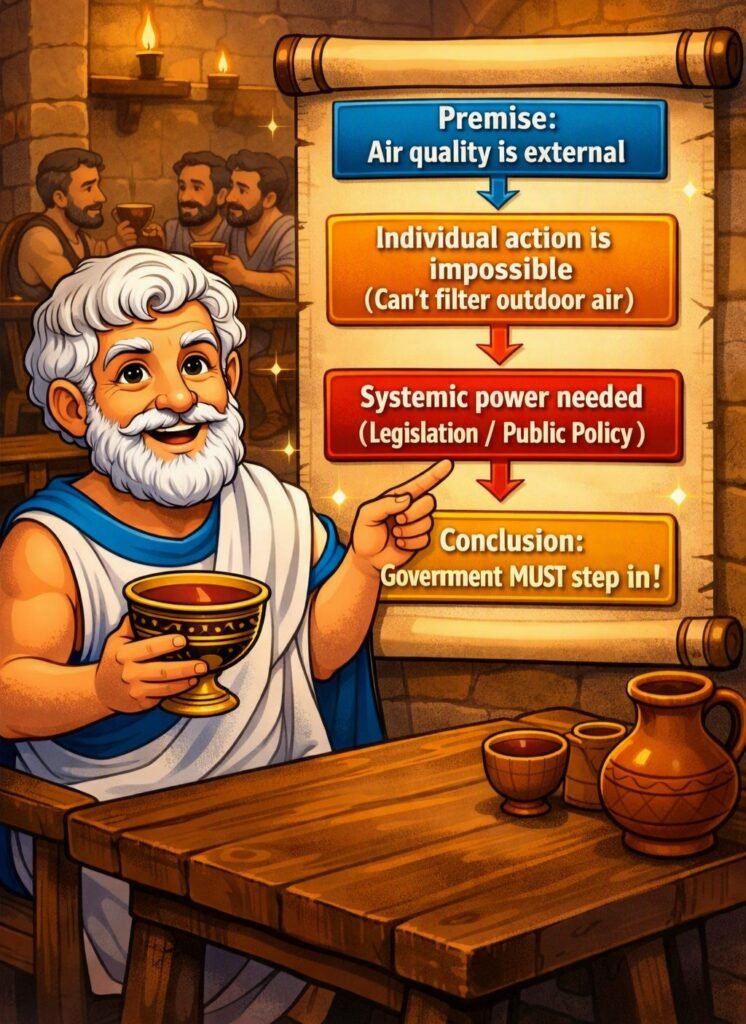
Notice the logical chain in Paragraph 1. It doesn’t rely on emotional outbursts (“Pollution makes me cough, so ban cars!”). It uses a clear comparison and deduction:
- Premise: Citizens can privatize some health choices (buying bottled water or organic food).
- Friction/Contrast: Ambient outdoor air cannot be privatized or filtered by an individual walking down the street.
- Deduction: Because the problem is ambient and collective, the solution must be systemic.
- Final Conclusion: Only an entity with systemic authority (the government) can regulate factories and vehicle standards.
This is pure Logos. The examiner cannot argue with this paragraph because every sentence locks into the next like a Lego brick.
B. How Logos Drives Body Paragraph 2 (The Economic & Health Chain)
Look at how Paragraph 2 links health directly to state finances using cause-and-effect:

By demonstrating that clean air actually saves the government money in medical costs, the argument moves beyond simple morality and presents an airtight financial reason for policy intervention. That is high-level Task Response.
C. The Subtle Masterclass of Ethos
Notice what the writer didn’t do:
- They didn’t write: “As someone who studies economics, I know…”
- They didn’t write: “In my personal opinion as a good human being…”
Instead, Ethos is built entirely through Academic Register:
- Precise topic vocabulary: “ambient air,” “particulate matter,” “human capital,” “legislative power.”
- Formal transition signals: “First and foremost,” “Furthermore,” “Therefore.”
- Zero emotional exaggeration (Pathos): The text never calls polluters “evil” or air quality “disastrous.” It remains calm, analytical, and objective.
The Ultimate Punchline for High Flyers
When you step into the IELTS exam room, leave your dramatic stories at home, leave your fake credentials at the door, and bring your logical brain.
- Ethos gives your essay an authoritative, academic voice.
- Pathos gets thrown out the window.
- Logos builds the step-by-step logical ladder that carries you straight to Band 8.0+.
Stack your facts, build your cause-and-effect chains, let the logic do the heavy lifting—and go get that university offer letter! Thank you, you’ve been a fantastic audience!